HERE ARE SOME IMPORTANT FACTS.
by Jeff Bridgman, 2013
We are all the stewards of these antiques we collect and sell. As they pass through our hands we should do them no harm and employ our best effort, given a practical measure of time and available resources, so that our children and those who come after us can enjoy them as we do.
Jeff R. Bridgman Antiques, Inc. employs expert staff with masters degrees from top programs in textile conservation, such as the University of Rhode Island and the University of Delaware / Winterthur Museum Fellowship. We coordinate the mounting and display of all of our flags on site. I personally select the very best new and antique moldings and the highest quality, natural fabrics for backgrounds, support, and masking. What follows below is a description of how we go about conserving and mount various types of flags, the frames that we use, and alternatives to traditional framing.
Remember while you are reading that any frame currently on a flag I am selling, as well as its background, can be changed to meet your wishes.
WOOL & COTTON FLAGS WITH PIECED-AND-SEWN CONSTRUCTION:
For most flags with pieced-and-sewn construction, the flag begins its journey by being hand-stitched on every seam and throughout the star field to 100% silk organza on the reverse for support. Organza is a virtually weightless fabric that is very tough. Among other uses, organza is used for support inside wedding dresses. We sew the flag to organza so that it simply doesn't hang on its own weight along the top row of stitches in the final mount. If that were to be allowed to occur, an ocean wave effect quickly develops that results in both a strain on the textile and an unsightly presentation.
If the flag has losses, 100% natural fabrics of similar coloration can be cut to fit behind these areas. Masking fabric, when needed, will be applied before or in place of the supportive silk. Sometimes it replaces the organza when the background fabric will show through because the fabric that the flag is made of is thin or loosely woven. This is especially true when we are using a black background. Masking fabric may also replace the organza if the flag has so many losses that piecing fabric to ghost them out is impractical.
The supportive fabric is turned under (doubled up) along the perimeter as the flag is hand-stitched to its background. We typically use black cotton that has been washed to reduce excess dye. An acid-free agent is added to the wash to further set the dye and the fabric is heat-treated for the same purpose. We also advocate the use of ivory colored natural fabrics as backgrounds, though shades of white can sometimes drain color from the presentation.
The background fabric is mounted with archival adhesive to coroplast (corrugated plastic). The flag is then hand-stitched to this prepared mount. The stitches go directly through the coroplast and are held fast on the reverse with archival tape. This keeps the stitches from slipping. If the mount is on the larger side, a custom-sized strainer frame is built to support it and the flag on its coroplast support panel is mounted over the strainer. The glazing we use is always U.V. protective, whether plexiglas or glass. If glass is employed, spacers are used to keep the textile away from the glass.
PRINTED COTTON FLAGS (PARADE FLAGS / HAND-WAVERS):
In most cases printed cotton or silk flags get hand-stitched to 100% natural fabric backgrounds. Coroplast support panels are used and, as-is the case with pieced-and-sewn flags, the stitches go directly through the coroplast and are secured on the reverse with archival tape. Larger flags require a strainer to support the mount. If black fabric is used for the background, it is treated for colorfastness by a combination of washing, the use of an additive to set the dye, and heat. The glazing we use is always U.V. protective, whether plexiglas or glass. If glass is employed, spacers are used to keep the textile away from the glass.
PRESS-DYED WOOL FLAGS:
Printed wool (press-dyed) flags are a hybrid between sewn and printed flags. They are generally heavier and for good measure we mount these in a fashion similar to pieced-and-sewn flags. Silk organza or taffeta is hand-sewn on the reverse along every stripe and within the star field. The flag is then finished in the same manner as a pieced-and-sewn flag (see above).
SILK FLAGS (pieced-and-sewn or printed):
Silk flags require special handling and are treated on a case-by-case basis. We have conserved and framed many that were in hundreds to thousands of pieces. It's not always a task for the meek of heart, but over time and through much practice, we have become very good at it. Feel free to contact me about especially fragile flags.
TRADITIONAL MOLDINGS:
The antique frames we choose for smaller flags are generally period to the flag or earlier. These I select and buy personally, before cutting them down to accurately fit the flags. This takes special care as the frames are generally 100-200 years old.
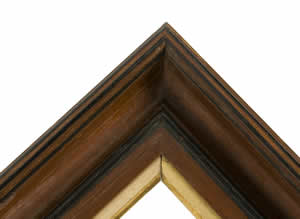 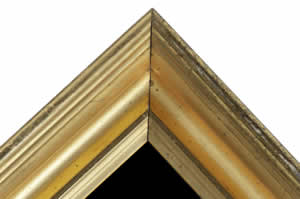 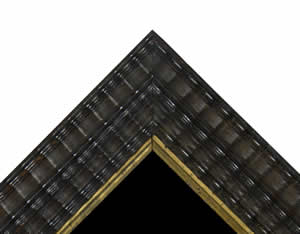
For larger flags, we use only the very best moldings. In particular, I prefer a black and gold or black and silver, Italian-made variety that is about 3.25� in width and 2.5� in depth. While expensive, I have found nothing to match them in terms in the early appearance of their hand-gilded, hand-distressed surfaces and the degree to which they effect the overall presentation of most Stars & Stripes flags. Further, they tend to work in every sort of setting, from rural to formal to ultra-modern.
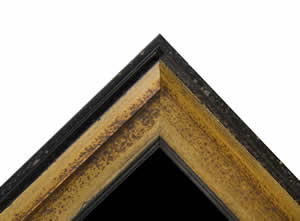 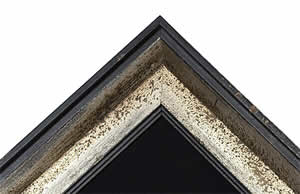 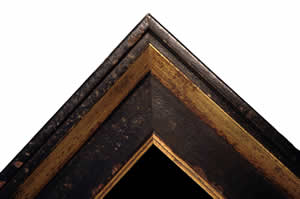
Many frame-makers attempt to make frames that look antique, but most fail in that attempt, especially under an eye that is used to seeing original surfaces on 18th and 19th century objects. While the style of the new moldings I use are not generally exact copies of period American moldings, the finish is unique in my experience with new frames, because it works very well with early surface American furniture, both painted and unpainted. This is almost never the case. In addition, they work just as well with polished, formal furnishings, European or American, new or old, as well as in a sleek, modern, contemporary home or office.
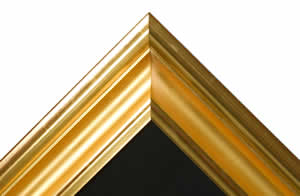
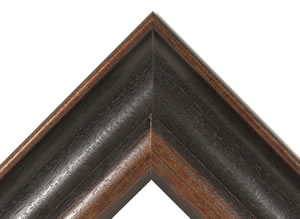
We also stock other options with beautiful profiles and finishes.
  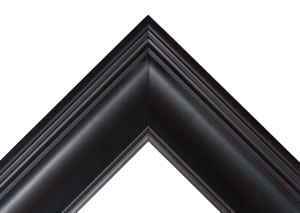
CUSTOM-BUILT, WELDED ALUMNINIUM FRAMES
In the case of some flags, especially very large ones, appropriate traditional moldings are sometimes unavailable. For example, the new moldings I use come in lengths of 9 or 10 feet, which can accommodate a flag that is 9 feet long or smaller. For a 10-foot flag, an alternative method is necessary. In these instances we typically custom-make welded aluminum frames with a 1 to 1.5-inch face and a powder-coated, satin black finish. The flag is conserved and mounted in the same general fashion as above, but always receive a supportive, strainer frame for this method of display. The aluminum frame slips over the supportive strainer and stainless steel screws hold it in place from the sides. We typically use black cotton twill backgrounds for these mounts, leaving about 2 inches of black fabric showing around the perimeter of the flag plus the 1 to 1.5-inch frame. Because the sides, front, and background fabric are all black, this gives the effect that the flag is simply floating on a black ground. It’s the logical alternative if a traditional molding cannot be used and the result is always beautiful.
The custom-built, welded aluminum frames described above save space over traditional moldings. These usually add 6.5 inches or so to the overall dimensions of a large flag, where the traditional moldings I use add between 11 and 13 inches. They are not, however, less expensive, because the process to custom build and paint and assemble them is tedious and costly and the supportive framework we use is much more substantial.
To save money, a flag can be conserved by stitching it to silk organza for support, then the silk can be rolled over to create an open sleeve at the top, through which a metal or wooden rod can be inserted. In this manner, the flag can be hung like a quilt, without a frame. I don’t recommend this for valuable flags, as it subjects them to light, dust and other degrading factors. But it is a viable option and is especially useful in the case of huge flags that are too big to be practical for framing. They can be hung high up on a wall in an area with a vaulted ceiling, for example, especially if it receives little direct sunlight.
We can also mount a flag as if we were going to frame it, then ship it unframed and without glazing, so that you can simply select your frame and glazing locally either when you receive it or at a later date.
When we do the above, we can also mount the flag on its coroplast support panel over a supportive wooden or welded aluminum strainer, so that you can hang the flag on a wall in a presentable fashion without any frame at all. We leave fabric showing around the flag, usually 2 to 3 inches, and continuing around the sides of the 1-inch deep strainer. This is a manner of presentation that you may sometimes have seen on mounted hooked rugs or quilts. With flags we basically do the same thing, using a more involved process of supportive stitching. Plexiglas and a frame, if desired, can go right on top of it at a later date to complete the framing process.
A more obvious alternative than any of the above is to use a less expensive and/or narrower molding. I have a selection of these and would be pleased to share them.
Feel free to contact me about all of your mounting and framing concerns. |
